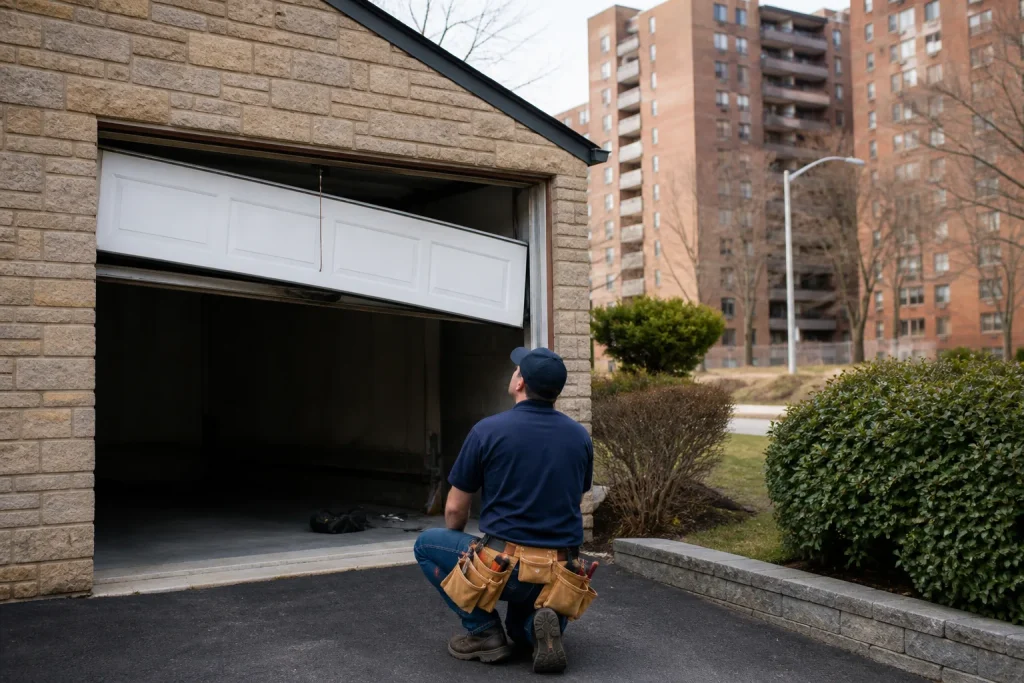
Garage Door Repair: Repair or Replace? How Co-op City Homeowners Decide
Most Co-op City homeowners ask us the same question in the same worried tone: “Do I need a whole new door, or can this one be fixed?” The honest answer is that it’s rarely a gut call. It’s a math problem with four variables, and you can work it out in about ten minutes. Treat the decision that way and you’ll usually avoid the mistake we see most often: replacing a door that still had years of life left in it.
Key Takeaways
- The “replace if repairs cost more than half of replacement” rule of thumb was built for appliances, not garage doors. Applied blindly, it pushes people toward a new door when a targeted repair would serve them fine.
- Four things decide it: door age, repair history, the type of damage, and whether you actually need better insulation.
- Some damage looks frightening and is cheap to fix. Some damage looks minor and signals real structural trouble.
- Co-op City co-op and HOA appearance standards can make a cosmetic replacement sensible even when the door still works.
Why the “50% Rule” Doesn’t Fit Garage Doors
The familiar guideline says replace a thing when repairs cost more than half of what a new one would run. It works reasonably well for a washing machine or a water heater, because those appliances have a single failure point and a fairly predictable lifespan. A garage door isn’t like that. It’s a system with two separate halves: the door hardware (panels, tracks, rollers, springs, cables, hinges) and the opener that drives it. The two wear at different rates and fail for different reasons.
That’s the trap. A broken spring or a snapped cable can look like a catastrophe and still cost a modest fraction of a new door, because only one component failed. Judging a whole door by one bad part is like scrapping a car because it needs brake pads. In our experience across Co-op City, a lot of “replace” decisions are actually single-component repairs wearing a scary costume.
There’s a second reason the rule misleads here. Replacement isn’t just the door. It’s removal, disposal, new hardware, possibly a new opener, and installation labor. Comparing a repair price to a bare door price understates the true cost of replacing, which makes repair look worse than it is. Price the whole job honestly before you compare.
The Four-Variable Framework, Weighted Honestly
Instead of one crude ratio, weigh these four factors together. No single one decides it on its own; the pattern across all four does.
- Door age. A door in the first half of its working life leans strongly toward repair. A door well into its second half deserves a harder look, especially if the panels or frame show wear.
- Repair history. One repair in several years is normal. A steady drumbeat of fixes points to a system that’s wearing out as a whole.
- Type of damage. A failed spring, a bent track, a dead opener, a worn roller: all repairable. Structural damage to panels or the frame is a different conversation (more on that below).
- Energy and insulation needs. If your garage sits under or beside living space and you want a warmer room above it or a more comfortable workspace, an insulated door may be worth it on its own merits, not because the old one is broken.
Run a door through those four and the answer usually surfaces fast. A mid-life door, one recent failure, a fixable part, no insulation need: repair wins clearly. An older door, several failures, structural damage, and a genuine insulation goal: replacement starts to make sense. Most Co-op City doors land somewhere in between, and that’s where the next two sections do the real work.
Which Damage Is Genuinely Beyond Repair?
This is where homeowners get spooked into spending too much. Plenty of damage looks alarming and isn’t. Here’s how we sort it.
Usually worth repairing:
- Panel dents and dings. Cosmetic, and often a single panel can be swapped without replacing the door.
- Surface rust. Treatable, especially on steel doors, as long as the metal underneath is sound.
- Bottom seal rot. A cheap wear item. Replace the seal, not the door.
- A dead opener or a single failed spring. Component-level fixes. We handle both, and being familiar with LiftMaster, Chamberlain, and Genie openers (plus Clopay and Amarr doors) means the right parts get matched the first time instead of the second.
Often a sign the door itself is failing:
- Deep structural creasing or a bent panel that throws the door off square.
- A cracked or bent track that keeps bending back after being straightened.
- Rotted wood at the frame or where hardware mounts, on wood doors.
- A door that sags or binds no matter how many parts get replaced.
The distinction matters because surface problems and structural problems wear the same face at a glance. A trained eye tells them apart in minutes.
How to Estimate Remaining Life from Spring Cycles
This is the number-based method most homeowners have never seen, and it’s the most useful tool in this decision. Torsion and extension springs are rated in cycles, and a cycle is one open plus one close. Standard springs are often rated around 10,000 cycles. Higher-cycle springs are rated for more.
Do the rough math on your own garage:
- Count your average daily open-and-close cycles. A household that comes and goes a few times a day might average four to six cycles.
- Multiply by roughly 365 to get a yearly figure.
- Divide the spring’s rated cycles by that yearly figure to estimate how many years the spring should last.
A door cycling six times a day runs about 2,190 cycles a year, so a 10,000-cycle spring is a rough guide of several years of service, and a higher-cycle spring stretches that further. Two things follow. First, a spring failure is largely a function of use, not neglect, so it’s a poor reason to condemn a whole door. Second, when you do replace springs, it’s worth asking for a higher-cycle rating to buy more time. This is one place where a little knowledge pays for itself.
A word of caution: springs sit under hundreds of pounds of tension, and a wrong move can cause serious injury. This is a professional repair, not a homeowner job. We say that plainly because we’d rather you stay safe than save a few dollars.
When Co-op City Building Standards Tip the Scale
In Co-op City, a lot of housing is co-op and HOA governed, and that changes the calculus. Appearance rules in a shared building or association can require doors to match a certain style, color, or condition. If your board has flagged your door’s looks, or if a worn door is the odd one out on your row, a cosmetic replacement can be a practical necessity even when the mechanism works fine.
So check two things before you decide. First, ask your board or management what the appearance standards actually are, in writing if you can. Second, separate the mechanical question (“does this door work and is it safe?”) from the community question (“does this door meet the building’s expectations?”). Sometimes the answer to the first is “repair” and the answer to the second still nudges you toward replacement. That’s not overspending; it’s answering two different questions. When a new door is the path, garage door installation covers how that job is measured and scheduled.
The One Scenario Where Replacement Almost Always Wins
There is a pattern that overrides the four-variable math: multiple different components failing within about an 18-month window. A spring goes, then the opener, then a roller, then the cable. When separate parts keep failing in a short span, it usually isn’t bad luck. It signals that the whole door and its hardware have reached the end of their service life together, and the next fix is just the next in line.
In that situation, repair becomes a subscription rather than a solution. You keep paying for one part at a time while the underlying structure keeps aging. Replacing resets the clock and often comes with a warranty on the new system, which is a real difference over the years.
If you’re weighing a new door against more repairs, garage door repair explains what a targeted fix covers, so you can compare it fairly against the full cost of replacement. And if the opener itself is the failing part, garage door opener repair breaks down the options there.
When to call a pro
Any time springs, cables, or tracks are involved, and any time a door won’t move freely or is binding, stop and call. Those are the dangerous, heavy-tension parts, and a proper diagnosis protects both your safety and your wallet.
The Bottom Line
The repair-or-replace decision is a math problem, not a feelings one. Weigh door age, repair history, damage type, and insulation needs together, and check your building’s appearance rules if Co-op City co-op or HOA standards apply. Use spring cycle ratings to estimate remaining life. And watch for the one pattern that overrides everything: several different parts failing inside an 18-month window.
Our technicians have up to 10 years of experience, and we work on the brand you already have, whether that’s a Clopay or Amarr door or a LiftMaster, Chamberlain, or Genie opener. If your door won’t move, that’s a security issue as much as an inconvenience, and we offer emergency service for exactly those calls. Whatever the job needs, one call covers it. If you’re in Co-op City and need help, Garage Door Repair Co-op City offers free estimates, call (844) 741-4548.
Frequently Asked Questions
Repair unless the door is toward the end of its life, has a history of repeated failures, or shows structural damage to panels, the frame, or the track. For a mid-life door with one failed part, repair almost always wins. Call (844) 741-4548 for a free estimate and a straight assessment.
It depends on how many times a day your door cycles and the spring’s cycle rating. Divide the rated cycles by your yearly cycles for a rough guide. Because springs are under heavy tension, this is a job for a trained professional, not a DIY fix. Call (844) 741-4548 with questions.
Often, yes. A single dented steel panel can frequently be swapped without replacing the whole door. Deep creasing or a bent panel that throws the door off square is a different matter. Get it looked at before you assume the worst, call (844) 741-4548 for a free estimate.
They can, if appearance standards require a particular style or condition. That’s a community rule, separate from whether the mechanism works. Ask your board what the standards are, then decide. For the mechanical side, call (844) 741-4548 and we’ll tell you plainly what needs fixing.
Written by the team at Garage Door Repair Co-op City.
Need Garage Door Help?
Call Garage Door Repair Co-op City - the local pro we connect you with is licensed and insured, here with fast after-hours help in Co-op City.
(844) 741-4548